
About Family Tree Alumni Network
Challenge: Students and recent graduates are navigating a competitive job market with fragmented information, unclear pathways to stand out, and limited access to meaningful professional networks.
Solution: Design a system that moves beyond one-off applications and cold outreach by creating sustained, human-centered alumni connections that support students throughout their early career journey.
Deliverables: UX Research, Design Strategy, Service Design, Concept Prototyping, Higher Ed
Timeline
Dec 2025
Role
UX Design & Research
Org
UW-Madison
Team
Lucy Murdock and Obid Ochilov
OVERVIEW
Soon-to-graduate students and recent graduates face an overwhelming and highly competitive job search. Job information is fragmented across platforms, application processes are time-consuming, and it’s difficult to understand how to stand out in a crowded market.
This challenge is intensified by a low-hiring environment, widespread virtual recruiting, and growing uncertainty around entry-level roles. Recent graduates are entering one of the most difficult job markets in over a decade, with unemployment rates higher than the national average.
Our project explored how students currently approach job searching, where they struggle most, and what kinds of support would make the process feel more navigable and human.

How might we support students and recent graduates in navigating the job application process so they can secure full-time roles aligned with their career goals?
RESEARCH METHODS
Target Users: Students and recent graduates (ages 21–32) actively searching for full-time employment.
Interviews + Collaborative Brainstorming Session: We conducted 5 one-on-one interviews as well as a facilitated brainstorm session with 5 UW-Madison students. I co-facilitated this session, guiding participants through prompts about their job search experiences, networking behaviors, and pain points. This format allowed us to capture story-based insights while also observing shared frustrations and patterns in real time. Notably, we asked each student in the brainstorm to take 3 minutes to rant about their current situation with the job search before we began this discussion. This allowed students to release their emotional strain and gave us unique insights that come from a person’s uninhibited feelings.
Survey: We surveyed 23 students and recent graduates to gather broader quantitative data and validate themes emerging from the brainstorm session.
User interviews with user names and images redacted for privacy.
USER PERSPECTIVES
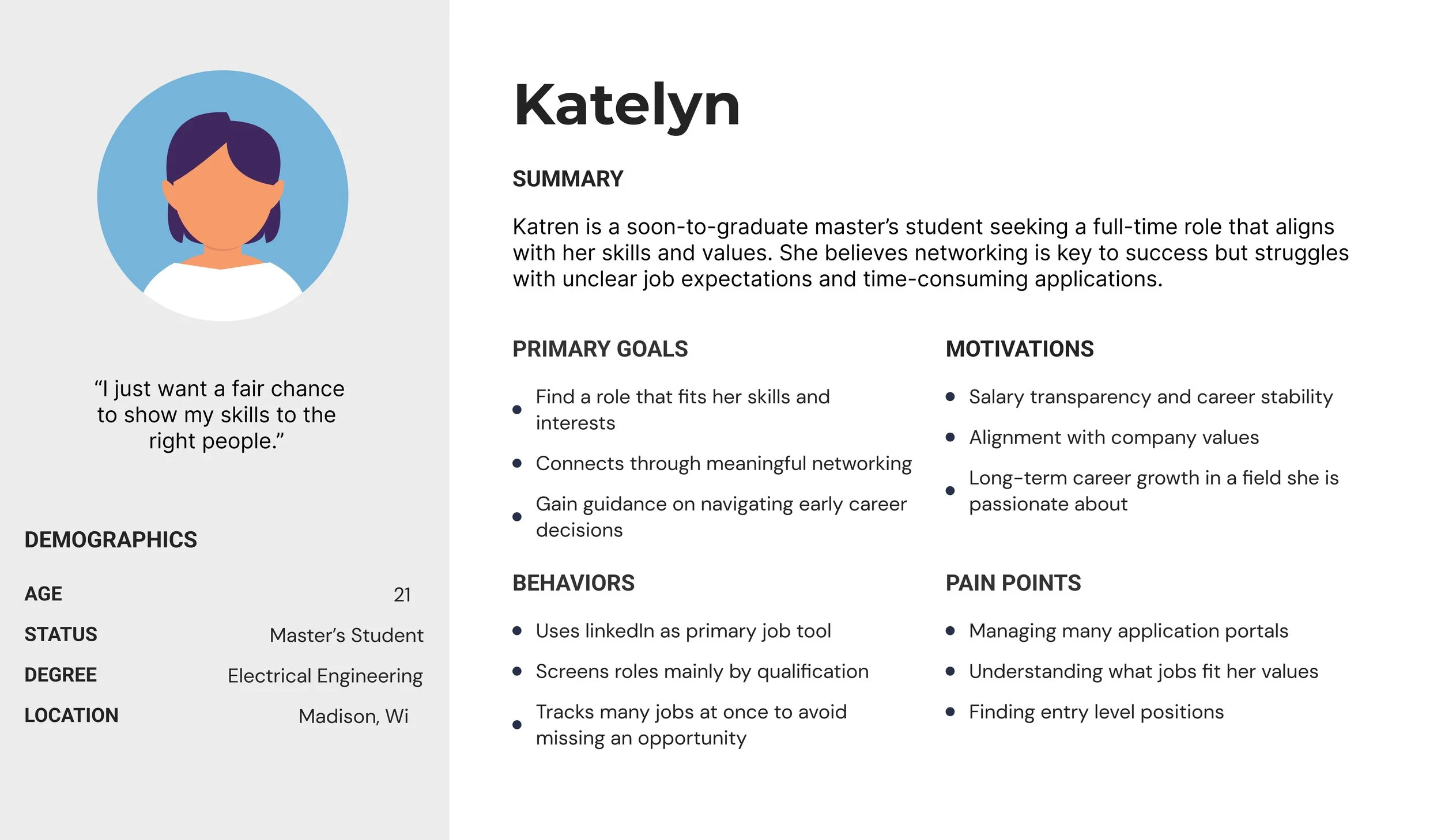
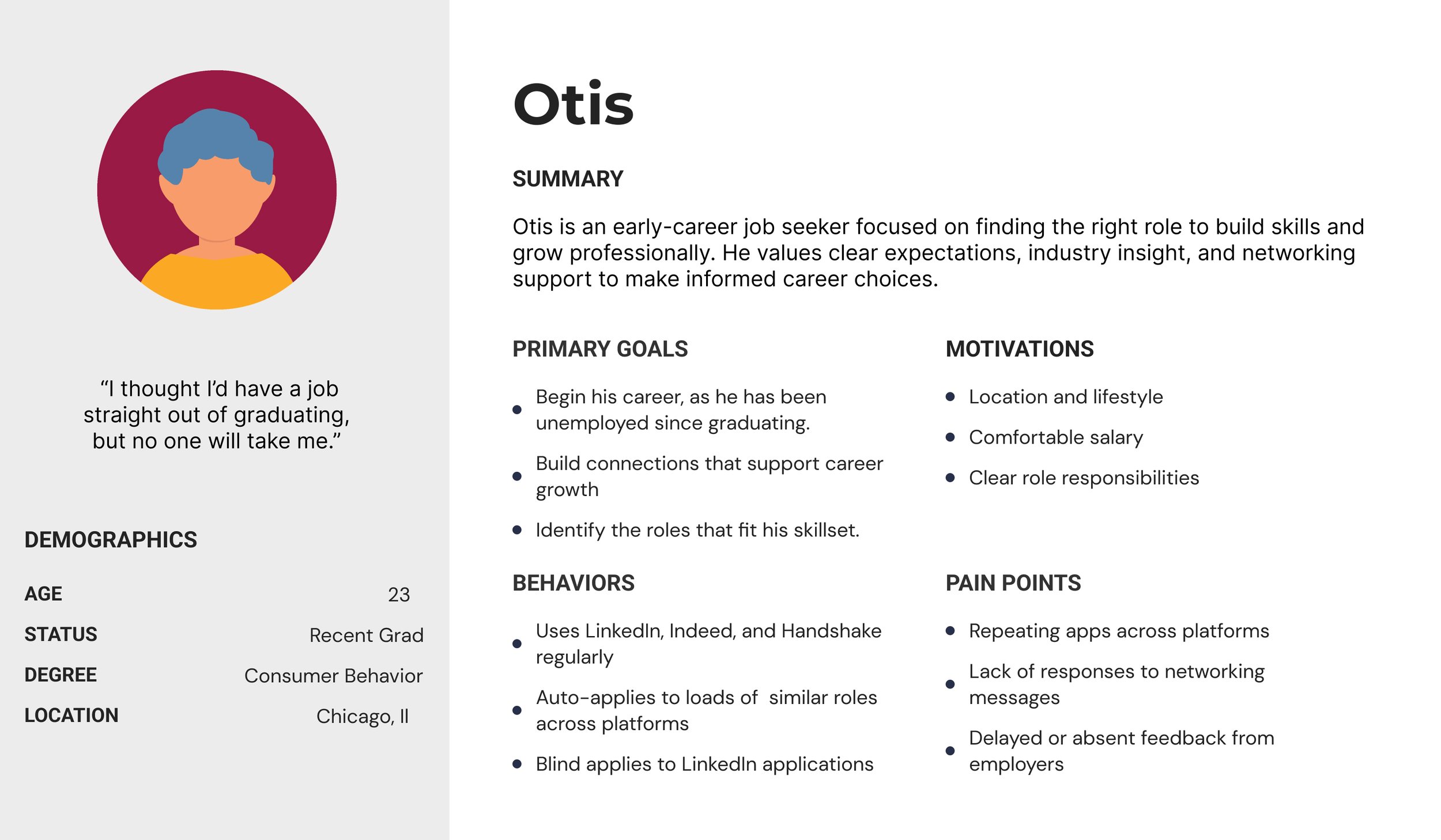
Synthesizing insights from surveys, interviews, and a co-facilitated brainstorm allowed us to identify key patterns in how soon-to-graduate and post-graduate students experience the job search, informing our core personas.
KEY INSIGHTS
Networking Is Essential, but Unequal
Students see networking as the key to getting hired, but most rely on cold outreach with little success. Without access to established professional networks, the job search feels unequal and discouraging.
Students Want Long-Term Mentorship, Not Transactions
Meaningful, ongoing relationships matter more than one-off conversations, yet current systems are not designed to support long-term connections.
Job Titles Create Confusion, Not Clarity
Unclear job titles and inconsistent expectations add confusion, pushing students to over-apply or rely on AI tools to make sense of listings.
OPPORTUNITY AREAS
Create systems that support long-term mentorship, not one-off networking
Reduce reliance on cold outreach and personal privilege
Help students make sense of unclear job titles and expectations
Design networking as an ongoing relationship, not a transaction
SOLUTION: FAMILY TREE ALUMNI NETWORKS
A long-term, generational networking system that pairs students with aligned alumni and grows into a multi-level “family tree.”
The system supports:
Early mentorship
Ongoing professional guidance
Multi-generational alumni relationships
Career insight across different stages of experience
Rather than relying on cold LinkedIn messages, students are introduced into a growing network that values continuity, trust, and shared identity.
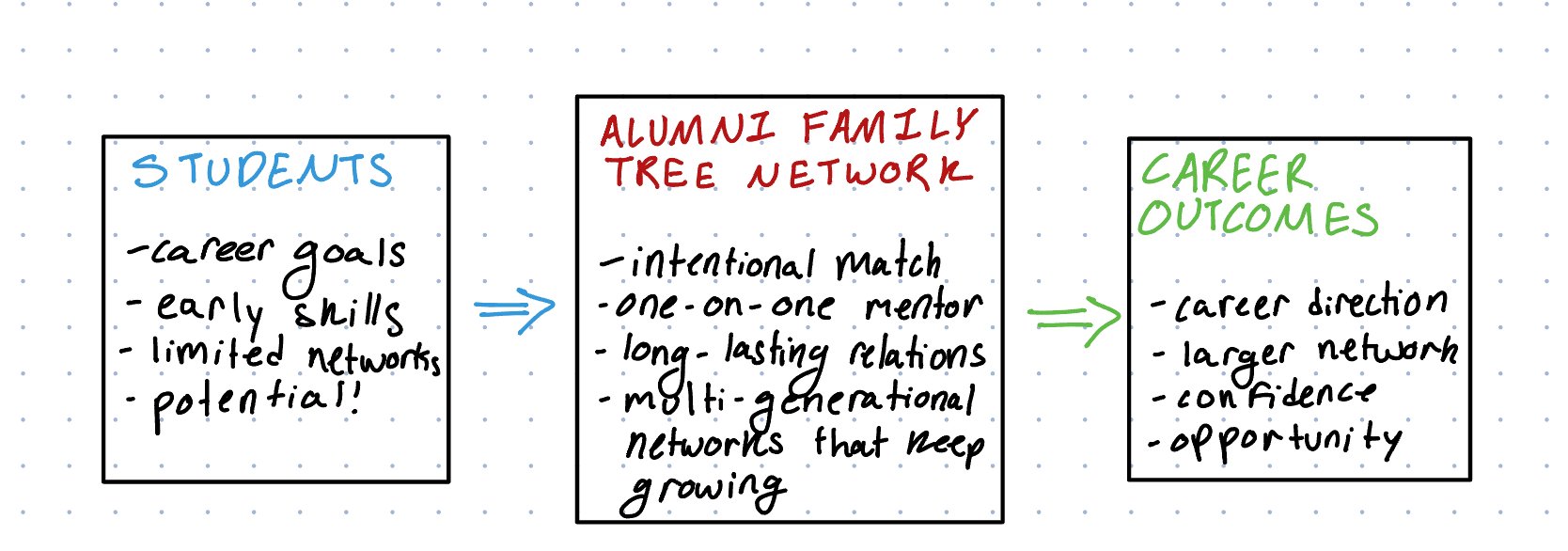
Concept ideation mapping.
EARLY PROROTYPING
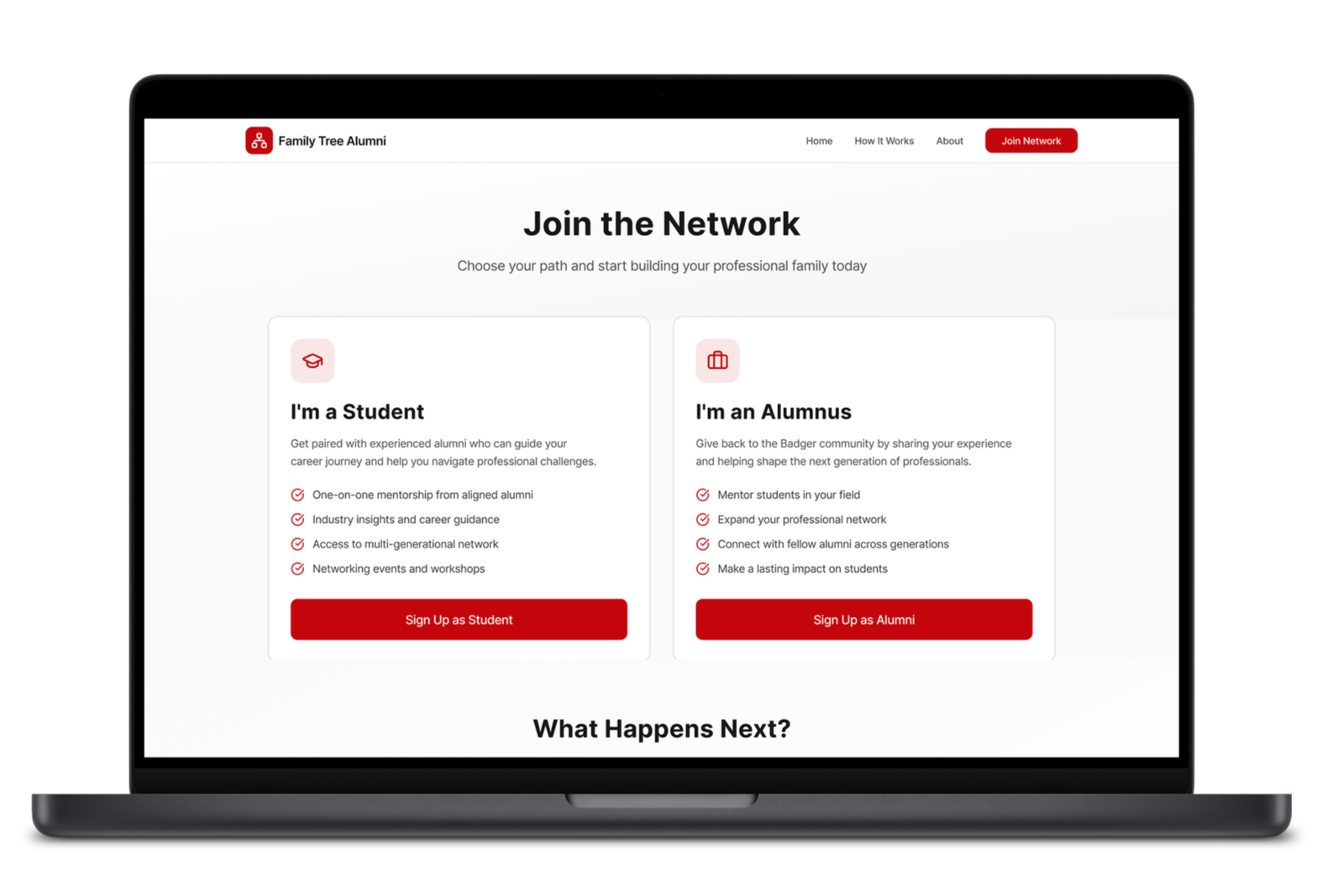
I created screens in Figma Design and dropped them into Figma Make to create an early concept website where the Family Tree system could live. The prototype focused on:
Clear entry points
Defined distinct paths for students and alumni to understand their role in the network.Intentional matching
Explored values- and interest-based matching to replace cold outreach with warm connections.Long-term mentorship
Framed mentorship as an ongoing relationship rather than a one-time interaction.Generational growth model
Visualized how mentees become mentors, growing the network across generations.
REFLECTIONS
This project strengthened my ability to synthesize research and translate real student experiences into system-level design. Co-facilitating the brainstorm session reinforced the value of creating space for honest, human insights. Using methods like “rant sessions” brought energy to the brainstorming session, relaxed interviewees, and surfaced unique insights.
Most importantly, this process highlighted how design can expand access to guidance and opportunity. By reimagining alumni networks as living systems, this work shows how design can better support students through the transition from education to career.